测试前,可以看一段C++之父的视频【需要番羽土蔷】:Bjarne Stroustrup: Why you should avoid Linked Lists

近期优化代码过程中,看了些c++性能测试相关的topic,然后看到 vector vs list performance在StackOverflow里被讨论的很多。于是,我也亲自来测试一把。
下面是我的测试代码:
#include <vector>
#include <list>
#include <iostream>
#include <string>
#include <ctime>
#include <time.h>
#include <sys/time.h>
#include <sys/stat.h>
#include <sys/types.h>

using namespace std;
using std::string;

class Message
{

public:
Message(){ this->head = 1; this->body="hello"; };
~Message(){};

void setHead(int head){ this->head = head; };
int getHead(){ return this->head; };

void setBody(const string& body){ this->body = body; };
string getBody(){ return this->body; };

private:
        int head;
        string body;
};

string getNowTimeNs() {
	struct timespec ts;
	clock_gettime(CLOCK_REALTIME, &ts);
	struct tm t;
	char date_time[64];
	strftime(date_time, sizeof(date_time), "%Y-%m-%d %H:%M:%S", localtime_r(&ts.tv_sec, &t));
	string s = ", ";
	return (date_time + s + std::to_string(ts.tv_sec) + s + std::to_string(ts.tv_nsec));
}


int main(int argc, char **argv) {

	Message *msg = new Message();
	std::vector<Message *> *myvector = new vector<Message *>();
	myvector->reserve(65536);
	std::list<Message *> *mylist = new list<Message *>();

	std::cout << "start vector push_back():" << getNowTimeNs() << std::endl;
	for (int i = 0; i < 65536; ++i) {
		myvector->push_back(msg);
	}
	std::cout << "end vector push_back():" << getNowTimeNs() << std::endl;

	std::cout << "start list push_back():" << getNowTimeNs() << std::endl;
	for (int i = 0; i < 65536; ++i) {
		mylist->push_back(msg);
	}
	std::cout << "end list push_back():" << getNowTimeNs() << std::endl;

	std::cout << "------------------------------------------" << std::endl;


	std::cout << "start vector iterator:" << getNowTimeNs() << std::endl;
	for (std::vector<Message *>::iterator it = myvector->begin(); it != myvector->end(); ++it) {
		//std::cout << ", " << *it;
	}
	std::cout << "end vector iterator:" << getNowTimeNs() << std::endl;


	std::cout << "start list iterator:" << getNowTimeNs() << std::endl;
	for (std::list<Message *>::iterator lit = mylist->begin(); lit != mylist->end(); ++lit) {
		//std::cout << ", " << *lit;
	}
	std::cout << "end list iterator:" << getNowTimeNs() << std::endl;

	return 0;
}
编译命令:
g++ vector_vs_list.cpp -std=c++0x -O2 -lrt -o pk
下面是我的测试结果:
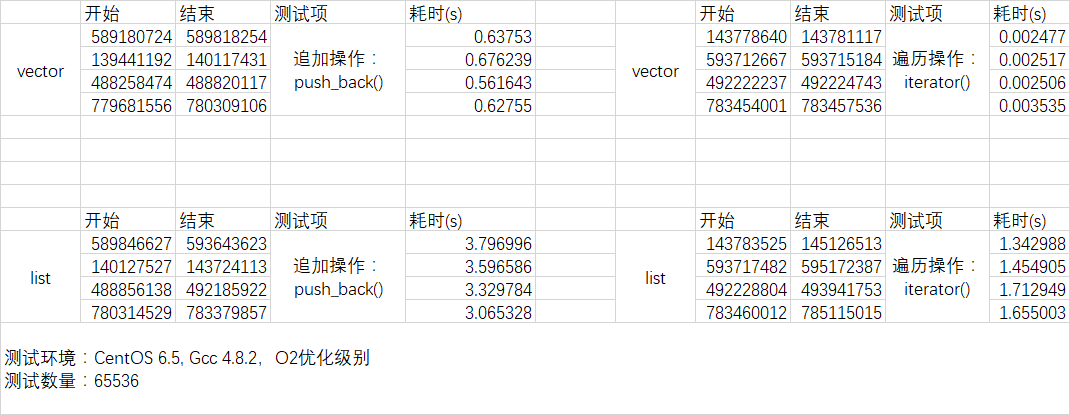
从测试结果可以看出,vector 在插入以及线性查找性能是远超list的。
下面附上国外网友的测试,可以作为参考:
我写了3个基于3个不同STL容器的基准测试:vector,list,deque。所有基准执行创建或销毁不同数量的对象,这些对象基于包含4个整数和少量函数的简单类。
第一个测试push_back函数的性能。
第二个测试随机插入的性能;
第三个测试随机删除元素的性能。
测试结果:
这里是运行3个基准测试1000,5000,10000和25000个对象的结果。
测试是在64位Kubuntu Linux 13.10机器上执行的,该机器采用Intel i7-4770 CPU @ 3.40GHz和8Gb DDR3 RAM。
所有的时间都是毫秒,较低的值(绿色)更好。
push_back
| 1000 | 5000 | 10000 | 25000 | |
|---|---|---|---|---|
| std::vector | 0 | 0 | 0 | 1 |
| std::list | 0 | 0 | 1 | 2 |
| std::deque | 0 | 0 | 0 | 1 |
insert
| 1000 | 5000 | 10000 | 25000 | |
|---|---|---|---|---|
| std::vector | 0 | 7 | 25 | 140 |
| std::list | 2 | 50 | 272 | 1893 |
| std::deque | 0 | 4 | 17 | 111 |
erase
| 1000 | 5000 | 10000 | 25000 | |
|---|---|---|---|---|
| std::vector | 0 | 5 | 22 | 139 |
| std::list | 1 | 69 | 395 | 2712 |
| std::deque | 0 | 5 | 18 | 126 |
从上图很容易看出结果......至少根据这些测试,push_back对于任何容器都还差不多,但对于其他所有操作,list是最差的容器,而deque是最好的容器。
附上测试代码:
更多参考:
C++ benchmarks: vector vs list vs deque
C++ Containers Benchmark: vector/list/deque and plf::colony
文章的脚注信息由WordPress的wp-posturl插件自动生成

 微信扫一扫,打赏作者吧~
![[整理][转载]win下网卡抓包发包库Npcap使用](http://www.jyguagua.com/wp-content/themes/begin/timthumb.php?src=http://www.jyguagua.com/wp-content/uploads/2023/08/demo_1-1024x711.jpg&w=280&h=210&zc=1)
![[转载]基础数据char,int,double,string是线程安全的吗?](http://www.jyguagua.com/wp-content/themes/begin/img/random/10.jpg)
![[整理]用c++编写的RDTSC性能计时器](http://www.jyguagua.com/wp-content/themes/begin/timthumb.php?src=http://www.jyguagua.com/wp-content/uploads/2020/12/rdtsc-assembly-example.jpg&w=280&h=210&zc=1)
![[整理]strcmp汇编写法](http://www.jyguagua.com/wp-content/themes/begin/img/random/16.jpg)
